
Wav2Vec2 Sentiment Analysis Using Shemo Dataset
Fine-tuning Wav2Vec2 for Persian speech emotion recognition on the ShEMO dataset, combining audio features with text transcripts for robust sentiment classification.
 Amirreza Vishteh
· 2 min read
Overview
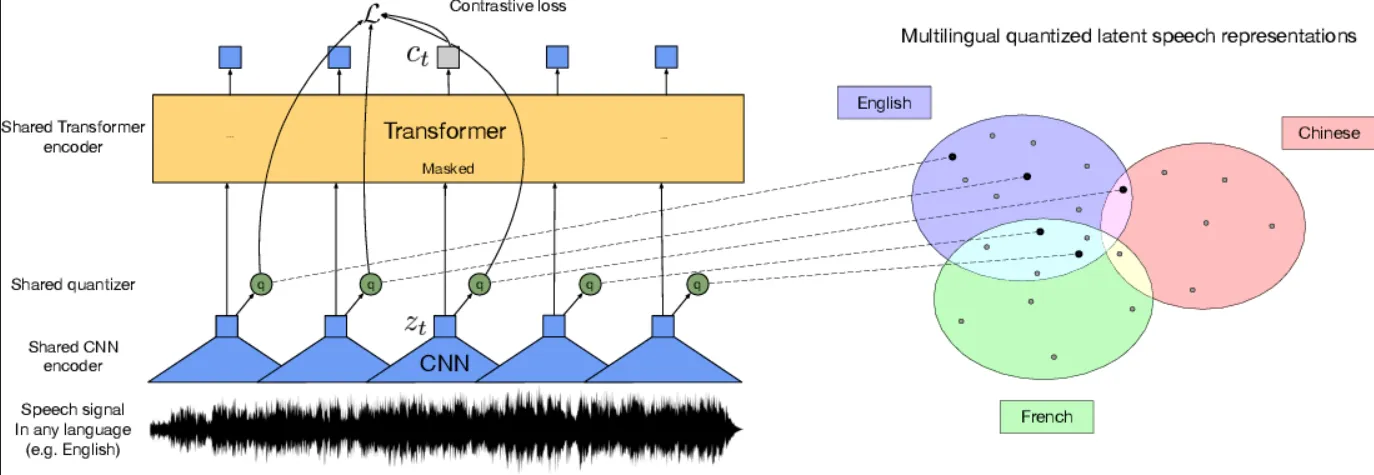
In this project, we fine-tuned the Wav2Vec2 model to perform sentiment analysis based on both voice features and text transcripts from the Shemo dataset. This hybrid approach allows robust emotion recognition using both audio and textual data for classification.
Team Members
- Amirreza Vishteh
- sentiment analysis in speech
- Iran University of Science and Technology
- 6/09/2024
Table of Contents
- Data Loading
- Data Preprocessing
- Model Configuration and Preprocessing
- Model Definition
- Trainer Setup
- Results
1. Data Loading
We used the Shemo dataset from Sharif University, which includes .wav audio files paired with corresponding transcripts and emotion labels stored in a JSON file.

2. Data Preprocessing
The loaded data was converted into a pandas DataFrame, and paths were verified to ensure file existence. Missing paths were dropped from the dataset.
The dataset was split into training (80%) and validation (20%) sets using stratified sampling based on emotion labels.

3.Model Configuration and Preprocessing
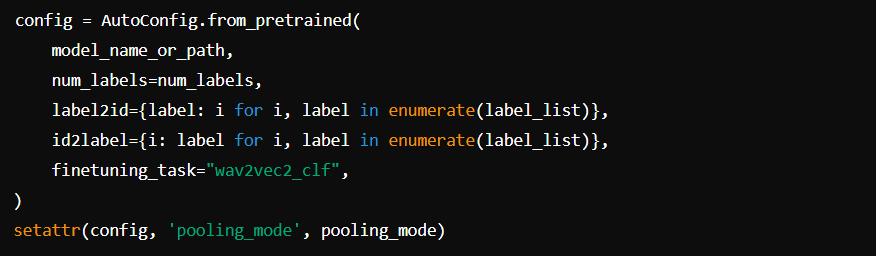
We loaded a pre-trained Wav2Vec2 model for Persian speech emotion recognition. Configuration was customized to set up the pooling mode and label mappings.

4.Model Definition
We defined a custom Wav2Vec2 model for speech emotion classification, which included a feature extractor and a classification head.
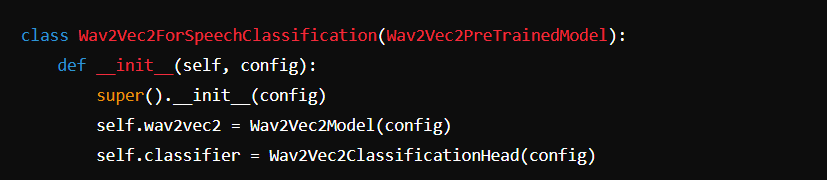
In the forward() method, hidden states from Wav2Vec2 were pooled, and the resulting tensor was classified into the target emotion label.
6. Trainer Setup
We used Hugging Face’s Trainer class to fine-tune the model. A data collator was implemented for dynamic padding, and evaluation metrics (accuracy, F1-score) were set up.
7. Results
After training the model, we evaluated its performance using the following metrics:
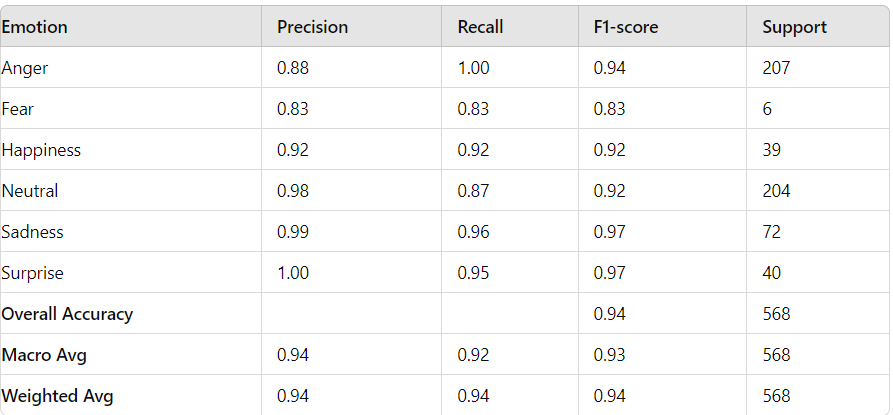
The final accuracy was 94%, demonstrating the effectiveness of using both voice features and text transcripts for sentiment analysis.